Every year bands form with dreams of becoming the biggest and best cover band in town.
They rehearse for hours.
Buy new gear.
Program lights.
Perfect harmonies.
Debate setlists.
Then years later they’re still playing the same venues, for the same crowds, for the same or less money, if they’re even still around.
Meanwhile, another band is playing festivals, corporate events, theaters, fairs, casinos, and major community shows.
The usual reaction?
“We’re better than them.”
But here’s the hard truth: you’re not better than them at the business of being a band.
And one of the biggest differences is booking.
No gig = no growth.
No gig = no income.
No gig = no audience.
No gig = people eventually forget you exist.
Momentum matters.
Ironically, too many gigs can hurt too. If you’re playing the same room every weekend, eventually your show becomes background noise. People stop seeing your performance as an event and start seeing it as a rerun.
The goal isn’t to play everywhere.
The goal is to play strategically.
The sweet spot is enough shows to stay relevant and enough scarcity to stay desirable.
Let’s talk about booking.
Booking Is Not Calling a Bar
“Hey, I’d like to play your bar. How much do you pa…”
Click. The phone hangs up before you can finish the sentence.
Why? Because venues hear that call all day long.
Booking Is Not Sending a Facebook message
“Hey, we’re available.”
That’s not a booking strategy.
What Is Booking?
Booking is relationship-building.
Booking is marketing.
Booking is branding.
Booking is professionalism.
Most importantly, it’s understanding what the buyer needs and showing them you’re the solution.
Venues, festivals, promoters, cities, and corporate clients aren’t looking to do you a favor.
They’re trying to create a successful event.
The bands that understand this get booked.
The bands that don’t usually spend their time complaining about why they aren’t getting booked.
Why Booking Agents Exist
There’s a reason many successful bands willingly pay booking agents 15% to 20% of the gross.
Because booking isn’t easy.
Most musicians think booking starts when someone says yes.
In reality, that’s often when the work begins.
As opportunities get bigger, the workload gets bigger.
A local bar show might require a few messages.
A festival, corporate event, theater, fair, casino, or large venue can involve:
Multiple phone calls
Dozens of emails
Contract negotiations
Technical riders
Stage plots
Hospitality requests
Insurance requirements
Production coordination
Marketing coordination
Scheduling changes
Deposit and payment terms
Last-minute problem solving
By the time the first note is played, there may have been weeks or months of communication behind the scenes. That’s why many successful bands invest in booking agents.
They’re not paying someone to make a phone call. They’re paying someone to build relationships, create opportunities, negotiate deals, handle the details, and make sure nothing falls through the cracks.
The bigger the opportunity, the more valuable professional booking becomes but a lot of bands treat booking like an administrative task. The most successful bands treat it like a profession.
Three People Who DON’T Understand Booking
1. The “I Know My Value” Guy
You’ve seen him.
He’s worth twice what every other band charges.
At least according to him.
He’s constantly posting about low-paying gigs, terrible promoters, and how nobody appreciates musicians.
To be fair, musicians should absolutely be paid fairly.
But markets don’t care about feelings.
Markets care about value.
If another band can bring the same crowd, create the same experience, and do it for less, your opinion of your value doesn’t matter.
The best bands don’t spend their energy complaining.
They become more valuable.
Bigger draw
Better production
Better marketing
More professionalism
More ticket sales
More reasons to say yes.
2. The “Know-It-All” Guy
You’ve met this guy.
You might have even been this guy.
This is the person who assumes they know more than the venue, promoter, sound company, production crew, and event staff combined.
Usually with very little actual experience.
They turn simple conversations into arguments.
They think every request is an insult.
Every show becomes drama.
Here’s a secret:
Venues remember easy people.
Venues remember difficult people too.
One gets called back.
One gets remembered.
3. The “We’ll Do It For Half” Guy
His entire strategy is:
“We’ll do it cheaper.”
Congratulations.
You just won the race to the bottom.
Undercutting everyone may get a gig today, but it weakens the entire market tomorrow.
Talent, preparation, professionalism, equipment, and experience all have value.
And let’s be honest, when a venue buys bargain-bin entertainment, they usually get bargain-bin entertainment.
Bad music
Weak crowds
Poor presentation
Disappointed customers
Live music isn’t the problem.
Bad live music is.
And when enough bad bands deliver poor experiences, venue owners start believing live music no longer has value.
5 Things To Help You Book More Shows
1. Be Easy To Work With
This alone will get you more gigs than being the most talented band in town.
Respond to messages.
Show up on time.
Do what you say you’ll do.
Avoid drama.
Reliability books shows.
2. Invest In Your Brand
Promoters buy confidence. Give them confidence.
Professional photos
Good live videos
Active social media
A simple website
A clean EPK
Make it easy for people to say yes.
3. Build Relationships
The best gigs rarely come from cold messages.
Support other bands.
Meet venue owners.
Talk with promoters.
Attend events.
Become part of the local music community instead of standing outside criticizing it.
4. Understand The Buyer’s Needs
Every venue is different.
Some need ticket sales.
Some need people drinking.
Some need dancing.
Some need background music.
Ask one question:
“What problem am I solving?”
The bands that answer that question get hired more often.
5. Create An Experience
You’re not just competing against other bands.
You’re competing against:
Netflix
TikTok
Football
Restaurants
People’s couches
Give people a reason to leave the house.
Great bands don’t just play songs.
They create experiences.
The Bottom Line
Most bands spend 90% of their time learning songs and 10% of their time learning how to get booked.
The bands that grow understand something important:
Talent gets you ready for the opportunity.
Booking creates the opportunity.
There’s a reason entire careers exist around booking and bands willingly give up 15% to 20% of their revenue to people who do it well.
Because great booking isn’t a side task.
It’s a profession.
You can be the greatest cover band on Earth, but if nobody books you, nobody will ever know.
The audience doesn’t attend rehearsals.
They attend shows.
So stop treating booking as something that happens after practice.
Treat it as part of the show.
Booking is the engine that makes everything else possible.
Happy booking. Cheers 247 Rockstar Booking and Entertainment.
Most musicians think being ready for the stage means mastering their instrument. They chase speed, polish licks, and obsess over technique. I know, because I was one of them.
I often think about the guitarist who can sweep pick like a machine but can’t hold down a simple groove, or the drummer who can blast at warp speed but falls apart when a metronome enters the room. They focus so hard on one thing that they forget what it really takes to get the gig, keep the gig, and earn their place on the stage.
There’s a fantasy that once you finally step onto a big stage, something inside you will click. You’ll suddenly know how to move, how to perform, how to command a crowd. That isn’t how it works.
This article comes from an old road dog, someone who lived through the glory days of the circuit and has spent the last decade on the other side of the stage as a venue owner and talent buyer. I’ve watched the scene shift in all kinds of ways, some good, some not so great. But one thing hasn’t changed. If you want to make fans, you need a core skill: knowing how to perform on stage. I don’t expect the wild chaos of the eighties rock era to come crashing back, but I do think the art of performing has taken a real hit somewhere along the line, and I think it’s part of why live music attendance has declined. Folks don’t go out just to hear music. They go to be entertained. If bands don’t know how to work the stage, the lackluster performance affects the entire ecosystem.
The Mirror Lie
When I was a kid, I practiced rock star moves in the mirror. I had the stance, the head tilt, the I’m about to melt your face look. But when I walked onto my first real stage, I locked up. I didn’t move, didn’t smile, didn’t even look at the crowd. I glued my eyes to the fretboard like it owed me money.
I see bands today doing the exact same thing. Young players, older players, even musicians with years of experience. I don’t know why. Did I miss the memo that said crowds don’t care? If so, that’s exactly the point. We want them to care.
If I could go back, I’d tell that kid to focus less on the air guitar in the mirror and actually rehearse those moves with the band. Over and over. I was focused on talent, and talent is only one ingredient. If we’re being honest, it’s not even the most important one. Song choice, performance, professionalism, connection. Those matter more.
I put a lot of time into trying to be the kid who could shred instead of the kid who could perform, and it took me about a year to climb out of that hole. It also took my sister being brutally honest about my stage presence. Thanks, Sis.
Bedroom Legends vs. Stage Masters
Today you can scroll through endless clips of players shredding in their bedrooms. Perfect tone, perfect edits, perfect lighting. Many of them aren’t even teenagers yet. They sound great, but most of them couldn’t survive a real stage. Playing for a camera is safe. Playing for people is a different sport that requires a different skill set.
Crowds don’t care about your technique. Musicians do. Crowds care about your energy.
They watch your face, your movement, your attitude. They want to see someone having fun. A wrong note played with confidence, tongue out, eyes forward, leaning into the moment will hit harder than a flawless arpeggio nobody hears because your mids are buried.
The Flat 5 Experiment
Around 1991, I decided to test this idea. One night on tour, I played a flat 5 over and over. It was nasty. Really nasty. I wasn’t trying to be clever. I wanted to see what happened if I sold it with everything I had. I leaned into the crowd, hand in the air, looking directly at them, and played like the note itself was a celebration.
The crowd went wild.
Not because of the note. Because of the presentation.
That’s when it clicked. Stage presence isn’t optional. It’s a skill, and you have to rehearse it. From that point forward, I made the decision to work less on technique and more on performance. People hear with their eyes.
It was a good time back then. Skinny, long hair, throwing the guitar around my neck and jumping off drum risers. Today I’m older and fatter, which limits me to the occasional smile, raised hand, lifting the guitar, and trying not to break a hip. The main thing is having fun and translating that to the crowd. Here’s a video if you want to see what this old guitar player looks like trying his best to entertain.
Why Angus and Slash Actually Win
People love to argue about who’s better. They’ll throw out names of players who live online, edit every note, and never set foot on a stage. Some of those players are phenomenal. But think about Angus Young. Think about Slash. They’re not the fastest, and they’re not chasing technical perfection. Yet every solo feels like a moment. Every move burns into memory. They don’t just play. They perform. Both have that rare, electric stage presence that turns a show into an real experience. Same for Metallica or even Green Day. Maybe that’s why they play arenas and everyone else is on YouTube. Maybe it’s just me but I could not imagine seeing any of those bands just standing there. It’s all about the stage energy.
Bottom Line
Whether you’re in your bedroom, your garage, or already gigging, practice how you play live. Your performance matters. Not just the notes but the movement, the presence, the connection.
You won’t magically figure it out once you reach a big stage. You earn the big stage by owning the small ones, every single gig.
After decades of performing, booking, owning venues, and just doing a lot of crap within the entertainment field, I’ve learned something that never stops being true: talent rarely ruins a career. Entitlement does.
The moment a musician starts believing their own hype, assuming they’re owed opportunities, or imagining that the world is plotting against them, things start to fall apart. I wrote this article because I’m seeing this attitude more and more and frankly, I’m tired of dealing with these people. It’s ugly and hard to watch some of these folks destroy their opportunities.
The Entitlement Spiral
A lot of musicians convince themselves that because they’ve put in time, or because they’re “good,” the industry owes them something. It doesn’t. No one is guaranteed gigs, attention, or success. The second you start thinking you’re above the grind, you stop doing the work that actually gets you hired.
When Good Intentions Get Twisted
One of the most frustrating things in this business is when someone tries to help—sharing gig opportunities, recommending bands, connecting people with venues—only to have it blow up in their face.
You share a gig posting and suddenly someone assumes you’re gatekeeping because they didn’t get picked.
They decide you must not like them.
They convince themselves you’re blocking their success.
They rewrite the story so they’re the victim and you’re the villain.
Most of the time, the person sharing the opportunity has zero control over who gets selected. They’re just trying to help. But entitlement has a way of turning everything into a personal attack.
Give an Inch, They Take a Mile
Another pattern that shows up constantly: you help someone once, and suddenly you’re their unpaid manager, promoter, and booking agent.
You recommend them for one gig, and now they expect you to recommend them for every gig.
You let them borrow gear once, and now they assume your rig is theirs anytime they need it.
You offer advice, they don’t take it, but they still expect you to keep helping.
You book them at your venue, and now they expect prime slots, weekends, and special treatment.
And when you finally set boundaries, they act like you’ve betrayed them.
Even This Article Will Ruffle Feathers
Here’s the funny part: even this blog will probably make someone think, “Is he talking about me?”
If you find yourself taking these words personally—if you feel attacked or exposed—that might be the first sign you’re drifting into believing your own bullshit. Growth starts where defensiveness ends.
This isn’t about calling anyone out. It’s about calling out a mindset that quietly destroys careers long before lack of talent ever does.
No, I’m probably not thinking about you. I’ve developed an advanced set of skills to simply write those people off to never think about again. LOL.
Shooting the Messenger
Another toxic habit entitlement creates is shooting the messenger. Someone delivers news you don’t like—maybe you didn’t get the gig, maybe the venue passed, maybe the lineup changed—and instead of handling it professionally, you unload on the person who simply relayed the information.
Here’s the reality: when you get entitled, defensive, or nasty, you’re not just reacting in the moment. You’re sending a message to everyone around you.
You’re telling them you’re hard to work with.
And in this industry and scene, that reputation spreads faster than your music ever will.
People talk.
Venues talk.
Bands talk.
Promoters talk.
If your first instinct is to blame, accuse, or attack the person delivering the news, you’re not hurting them—you’re hurting yourself. You’re showing everyone that you’re unpredictable, emotional, and difficult to collaborate with.
Once that label sticks, it’s almost impossible to shake. Nobody wants to deal with drama.
The Reality Check
The music industry is simple:
It rewards
Consistency, professionalism, humility, collaboration, and self-awareness.
It punishes
Ego, entitlement, blame-shifting, delusion, and lack of gratitude.
The musicians who last and frankly are the ones getting shows aren’t the ones who think they’re owed something. They’re the ones who treat every opportunity like a privilege, not a right.
The Hard Truth
If you want longevity in this business, you have to stay grounded. Appreciate the people who help you. Don’t resent them when things don’t go your way. Avoid the trap of believing your own bullshit, because once you start thinking you’re above the grind, you stop doing the things that actually get you hired.
The industry is tough enough without creating imaginary enemies. Stay humble, stay hungry, and remember: the moment you think you’re owed something is the moment you stop earning it. Rock on. Sorry for ruffling your feathers sweetheart.
Y’all listen up— you may be killing your bookings and not even know it.
I’m writing this from three angles: as a band leader who wants to stay booked, as a booking agent who’s seen every kind of attitude walk through the door, and as a venue owner who genuinely tries to give people a shot. And after all these years, I can tell you exactly what makes or breaks a band. In this article, we’re gonna talk about a big one.
What the hell am I talking about? Being a professional and having the right attitude.
I’ve watched opportunities fall apart over one defensive tone, one careless comment, one moment of ego. I’ve watched bands convince themselves someone is “gatekeeping” them, when really… the door closed because of how they showed up and how they kept showing up.
And here’s the truth nobody wants to hear: the thing that keeps bands booked isn’t always talent. It’s attitude. It’s professionalism. It’s trust.
What Most Bands Don’t See
Musicians obsess over tone, gear, practice hours, and follower counts. But venues don’t rebook you because your pedalboard looked cool. Many times, they rebook you because you were simply easy to work with.
From a venue perspective, every booking is a risk. We’re asking:
Will they show up on time?
Will they treat my staff with respect?
Will they communicate clearly?
Will they make my venue look good?
Will they make this easy—or make it a headache?
And here is the deal, Margins are tighter than ever. Live music is declining and no venue is going to babysit a band’s ego.
And here’s the part musicians forget: the audition starts long before the first note. It starts with the first text, the first email, the first phone call.
Pro TIP: Match the Energy You’re Given
One of the easiest ways to win in this business is simple: match the professionalism you’re shown.
If the talent buyer is clear, prompt, and respectful—match that. If they’re organized—be organized. If they’re warm and personable—lean into it.
This isn’t being fake. It’s understanding that this is a business relationship, not a casual hang. The way you communicate tells a venue everything they need to know about how you’ll behave on show night.
Story 1: The “You’re Trying to Scam Me” Moment
Not too long ago, I reached out to someone who claimed to understand shows. They talked like they’d promoted before and wanted to help build something. I was planning a showcase, so I figured—why not bring them in?
I explained the margins we had to hit, the sales goals, the guidelines. Basic promoter talk.
But the second I mentioned margins, they flipped. Suddenly I was “charging them,” “trying to make money off them,” “hiding something.” Meanwhile, I was fronting everything—space, lights, insurance, PA, staffing, marketing.
In that moment, I realized: I wasn’t talking to someone who could think like a partner. I was talking to someone stuck in victim mode. It also occured to me this type of person doesn’t invest.. they only take.
And honestly? Maybe they’d had bad experiences with shady venues before. I’ve had dealing with some shady venues but at some point, you have to ask: Was it the venue… or was it their mindset all along?
Either way, that mindset kills opportunities faster than a bad set ever will. So the conversation ended—not because I wanted it to, but because I couldn’t build anything with someone who didn’t understand the business side of the business.
Story 2: Choose Your Words Carefully
Another venue owner recently told me a story that still makes me think about my words I use and how simple things can be perceived.
The venue offered a band earnest money upfront to secure a date. They didn’t have to do that. It wasn’t contractual but the venue was wanting to show investment, goodwill and most importantly, trust.
As told, the band leader took the money, counted it like it might be fake, and with attitude said:
“I guess that’s good enough.”
Those words said everything the band didn’t intend:
I don’t trust you.
You didn’t do enough.
I’m doing you a favor.
Your gesture means nothing.
What the venue expected was simple: “Thank you—we appreciate the trust or partnership.”
Unfortuantly, that tiny moment cost them every future gig in that room. The owner told me later, “If that’s how they act when things are going well, imagine how they’ll act when something goes wrong.” They made it a point to tell me “that guy is an asshole and to never book them”. Imagine if they are telling me that, they are telling everyone that.. and this guy had a big reach.
And just like that, the band was off the roster for that venue.. forever.
“Good Enough” vs. “We Appreciate You”
“Good enough” is a scarcity mindset—always measuring what you think you’re owed. “We appreciate you” is a business mindset—focused on long-term relationships.
One closes doors. The other opens them.
The Network Is Smaller Than You Think
Within 150 miles, venues, buyers, and organizers all talk. I’ve been in those conversations. I’ve heard the warnings. I’ve heard the praise.
Burn one bridge, you burn five. Impress one venue, you impress ten.
And yes—this goes both ways. Venues that treat bands poorly get talked about too. That’s just a whole other article. Today we’re talking about what musicians can control.
Shift Out of the Artist Mindset
Artists think: Did they like our sound? Did we play tight? Did the crowd vibe?
Professionals think: Did we deliver value? Did we make the venue look good? Did we communicate clearly? Did we make this easy? Did we build trust?
When you make that shift, you don’t just get more gigs—you get better-paying gigs. Venues pay more for bands they trust, not just bands they enjoy.
Your attitude is part of your product. Your professionalism is part of your draw. Your gratitude is part of your brand.
And in a relationship-driven industry, those three things matter more than most musicians realize. Be cool and rock on.
“I can’t believe Venue X. The owner, todd, cut our set short, kept complaining about our volume—hello, we’re a rock band! We’ve played at that volume for years… then… he cancelled not just our future shows but my friends bands as well (band 1, band 2, and band 3). Venue X is the worst! people should not go there.”
Felt good to write that? Maybe. Until you realize your band is now unbookable because area venues now see you as a liability based on your public post history.
Great job bro.
– You insulted the owner / venue – You insulted the patrons – You tied other bands into your drama – You forgot you were the hired help – You tried to weaponize your followers
Why Bands Should Never Trash Venues on Social Media
In the connected world of live music, your social media presence isn’t just your promotional platform—it’s your professional reputation on permanent display. Every venue owner, booking agent, and talent buyer in your scene is likely just a few clicks away from seeing exactly what you post. And one angry rant about a bad gig can quietly close doors you didn’t even know existed.
The Temptation to Vent
We’ve all been there. The sound system was terrible. The venue was empty. The owner was asking you to turn down constantly. You loaded in during a rainstorm, played to twelve people, and made $100 split four ways. The frustration is real, and social media offers an immediate outlet.
But before you hit “post” on that scathing venue review or tag other bands in a complaint, understand this: the music community is smaller than you think, and it has a long memory.
The Reality of Social Media Screening
A recent survey of independent venue operators found that 78% regularly check a band’s social media presence before booking them for the first time. They’re not just looking at follower counts or engagement rates—they’re assessing professionalism, attitude, and potential liability.
Booking agents and venue owners use social media as due diligence. They’re evaluating not just your music and draw, but whether you’ll be professional to work with. Negative posts about other venues, bands, complaints about sound engineers, or public disputes about payment all serve as red flags that suggest you might be difficult to work with.
This scrutiny intensifies if a band has been removed from a schedule. Whether the cancellation was justified or not, how you handle it publicly becomes a litmus test for your professionalism. Industry professionals report that a band’s reaction to being bumped or canceled is one of the strongest predictors of future working relationships.
What NOT to Do: The Cardinal Sins
1. Don’t Post Immediately After a Disappointing Show
Emotions run high after a bad gig. You’re tired, frustrated, and maybe had a few drinks. This is precisely when you should step away from your phone.
Posting while emotions are high not only impacts you and your band, but also leads to other bands commenting, which can create a cascading effect that amplifies the negativity and becomes part of your tangled web.
The 48-Hour Rule: Wait at least two full days before posting anything negative about a show experience. If you still feel compelled to address it after cooling down, do it privately and professionally through direct communication.
Pro Tip: Draft your frustrations in a private note app or journal instead of social media. This gives you an outlet without the permanent public record. After 48 hours, review what you wrote—you’ll often find the issue doesn’t warrant public comment at all.
2. Don’t Name Names or Tag Venues/People
Even if you think you’re being subtle, calling out specific venues, promoters, or staff members is professional suicide. The music scene operates on relationships, and public call-outs poison those relationships irreparably.
3. Don’t Air Financial Grievances Publicly
Complaining about low pay, poor door splits, or feeling financially exploited might feel justified, but it’s a conversation for private channels—or better yet, your contract negotiations for next time.
4. Don’t Weaponize Your Followers
Using your social media following to brigade a venue, encourage negative reviews, or rally support against a booker is not activism—it’s bullying. And it will absolutely mark you as a liability.
When You’ve Been Wronged: The Professional Alternative
This doesn’t mean bands should accept genuinely bad treatment silently. If you’ve been truly wronged—not paid as contracted, subjected to unsafe conditions, or discriminated against—you have every right to address it. But there’s a right way to do it:
Handle it privately first: Email, phone call, or in-person meeting. Document everything. Give the venue a chance to make it right.
Use proper channels: If there’s a musicians’ union or local advocacy group, work through them. If contracts were violated, consult with a lawyer.
Be factual, not emotional: If you must address something publicly, stick to verifiable facts. “We were not paid according to our signed contract” is different from “This venue is run by crooks.”
Focus on solutions, not revenge: “We’re working to resolve a payment issue” maintains professionalism while acknowledging a problem.
The Ripple Effect You Don’t See
Here’s what bands often don’t realize: venue owners, promoters, and booking agents all know each other. They share information. They warn each other about difficult acts.
“We have a regional booking group chat,” admits one anonymous promoter. “When someone books a band that turned out to be nightmarish, they let the rest of us know. Bands that trash venues online come up constantly. We’re not blacklisting anyone officially, but why would I book someone who might turn around and make me their next social media villain?”
Your local music scene is an ecosystem. Every venue owner knows the other venue owners. Every promoter has worked with every other promoter. When you publicly attack one, you’re not just damaging that relationship—you’re demonstrating to everyone watching how you handle conflict.
Building a Reputation That Opens Doors
The inverse is also true: bands that handle difficult situations professionally build reputations that create opportunities.
Your online presence should showcase:
Gratitude: Thank venues, even for small shows
Professionalism: Post about your craft, your growth, your music
Community: Support other local bands and venues publicly
Solutions: If you must address problems, frame them as learning experiences
The Bottom Line
Social media is permanent, public, and searchable. That angry post you make tonight could cost you opportunities five years from now. Every venue owner is one search away from your entire digital history.
Assume every post you make will be read by every person you’ll ever want to work with in music. If you wouldn’t say it in a professional email to a booking agent, don’t post it on social media.”
The music industry is built on relationships and reputation. A single negative post might feel satisfying in the moment, but it can mark you as a band that brings drama, conflict, and liability. And in an industry with more bands than stages, venues will always choose the path of least resistance.
Your music and band might be incredible, but if venues see you as a potential social media nightmare, you’ll never get the chance to prove it. Keep the complaints offline, the professionalism online, and the bridges intact. Your future career will thank you.
As for that venue that did you wrong, mark them off your list. Simple.
As I was sitting here at Annies resturant in Enterprise (Great food BTW) doom scrolling, i figured there was no better time to start writing an article.
If you are like me, how many times have you scrolled through Facebook and seen a video or photo of a band at a gig and thought, “Wow, looks like nobody showed up”? Worse yet, maybe you thought, “That band must not be very good if they can’t draw a crowd?” (you can bet venue owners are thinking it).
Here’s the reality: as musicians, we can’t always pack the house. But what we can control is how we present ourselves. With some smart choices about photography and video, you can protect and elevate your image—literally—regardless of the size of the crowd.
The thing is, every band needs great photos—they’re your visual handshake with potential fans, venues, and industry folks.
However, the environment you choose and how you frame your shots can make the difference between looking like seasoned pros or just another bar band. And if you’re a solo artist, these principles apply just as much to you—perhaps even more so, since you’re the entire brand.
This Is Marketing, Not Deception
Let’s be clear: being selective about your visuals isn’t dishonest—it’s marketing. It’s putting your best foot forward.
Examples: Apple doesn’t photograph iPhones in the factory.
Just like restaurants carefully plate their dishes to create that premium visual experience (check out Annie’s for a perfect example), the photos you choose are strategic decisions about which moments best capture your music’s essence and energy. Every successful band understands this—it’s about visual storytelling that represents who you are.
Annie’s Quesadilla Burger. Notice they took the time to plate it and make it look more presentable. Rock on. It’s things like this that win Best burger 13 years in a row. Remember kids: People hear with their eyes.
P.T. Barnum said it best: “Without promotion, something terrible happens… nothing!” You can be the most talented band in your city, but if you’re not presenting yourself well, you’ll stay invisible. But here’s the catch—the wrong promotion also leads to nothing.
Learn from What’s Around You
Look at the successful bands in your area versus the ones grinding for years with little growth. Often, the difference isn’t the music—it’s the image. Those stagnant bands might be incredibly talented, but their social media screams “meh” with poorly lit videos and distracting backgrounds. Meanwhile, bands moving up have cohesive, professional content that makes bookers take notice.
Perception shapes opportunity. Something as simple as upgrading your image could be what’s holding you back.
Know Your Environment and Plan Accordingly
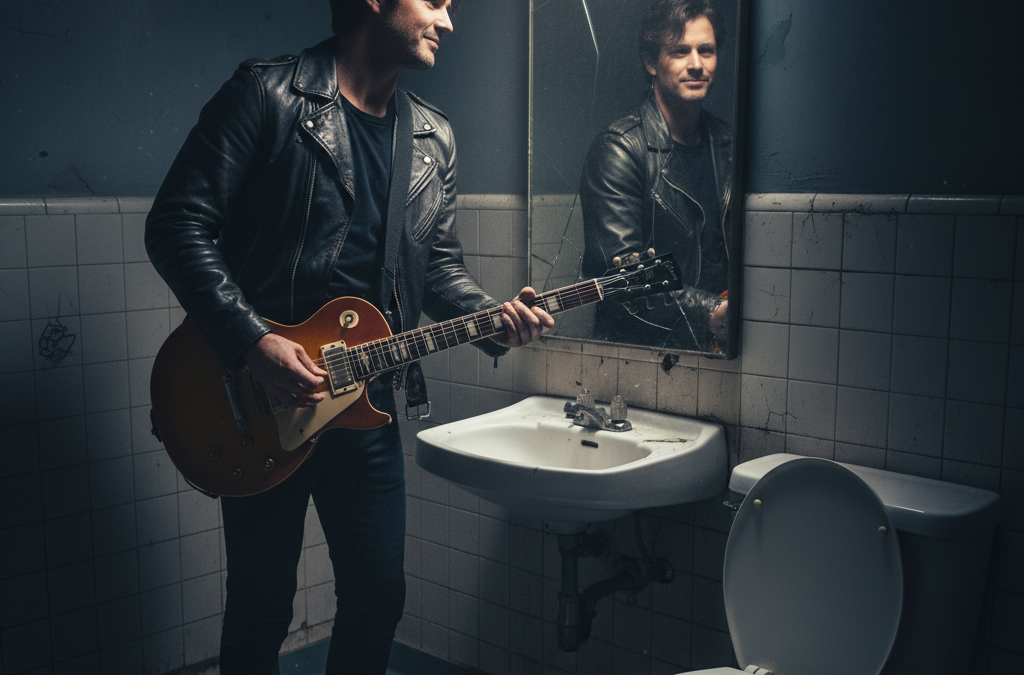
Playing next to the bathrooms? Got a Bud Light sign dominating the background? These details tell a story—and it might not be the one you want. If you’re positioning yourselves as a premium act, be selective. Scout angles that showcase your performance without broadcasting every detail of a less-than-glamorous venue. Sometimes the best shot focuses tightly on the band, using creative framing to eliminate distractions.
Take Advantage of Every Opportunity
Sometimes the best opportunities are the ones you have little control over. Opening for a bigger band? Sure, nobody’s actually there to see you—but that room is packed, the lighting is professional, and the stage setup is premium. Get those shots. Your impact of playing your music is the same regardless of why people are there. All those people are experiencing your brand, and you’ve got the visuals to prove you can command a real stage. Beats playing next to the bathrooms, doesn’t it?
These moments don’t come often, so when they do, capitalize on them. Have someone ready with a camera. Capture multiple angles. Get video. This is the content that elevates your entire promotional presence. Even if the audience is there to see someone else, take advantage of it—you’re on that stage, and you earned it. (and don’t let the other musicians who want to be on that stage try to minimize what you have accomplished, they are jealous)
Let me show you what I mean using Rock Mob’s performance at the National Peanut Festival last week. The two images below tell completely different stories about the same night. Even though 18,000+ people were there and heard us play, these photos create two distinct perceptions of the show.
Quick reality check: no band playing a fair like the National Peanut Festival should assume most people showed up specifically for a cover band—that’s just not realistic. But capturing killer content from that opportunity? That’s smart business. That’s what professionals do.
Example 1: Taken from the front where people walk in between the stage to get to the fair (i.e. street you don’t block).
Example 2: Taken from a standpoint behind the crowd… many in line to get a corn dog. Thank you Corndog Man.
A Professional Perspective
Savanna Kirkland of Embrace Photography / 247 Rockstar Entertainment, a local band photographer who knows a thing or two about capturing the energy and excitement of live music, says:
Capturing live music is about more than just photographing a band. It’s about capturing the energy and emotion that fills the room when they play. If anyone is looking for a band, the pictures/videos they present should show the intensity that a band could bring to their event. Each image should tell the story of the music, being a musician’s wife helps me appreciate the music first and my pictures are proof of that. The goal isn’t just to document the moment, but to let viewers feel it, as if they were standing right there in front of the stage or in the back enjoying the music with the rest of the crowd. Anybody can take a picture but it takes knowledge of angles and how to frame the shot to elevate the band’s image. It’s the art of using stage lights and angles to make the smallest stage appear as big as a festival hosting thousands.
Get Creative with Your Angles
Whether you’re playing to 10 people or a thousand, perspective is everything. Shoot from behind the crowd—even a small one. Getting low and shooting from behind a few people creates the illusion of engagement and energy. Those silhouetted heads in the foreground, the band lit up on stage—that’s the money shot.
Play with different heights and angles. Get down low. Shoot from the side of the stage. Capture moments between songs when band members interact.
Video: The Same Rules Apply
If there’s nobody in the crowd, don’t pan to the empty room. Keep your video focused on the band and the performance. A tight shot of your guitarist’s solo or your vocalist connecting with the mic is compelling content. A slow pan across empty tables? That kills momentum.
This is marketing fundamentals. Keep your video content focused on what matters: the music, the performance, the energy you bring.
The Bottom Line
Great band photography and videography is about being intentional. Be strategic about your environment, creative with your angles, and remember: you’re not just documenting a gig—you’re building a brand. That’s just good sense—putting your best foot forward.